
Baby Crib Assembly Safety Checks Every Parent Should Know

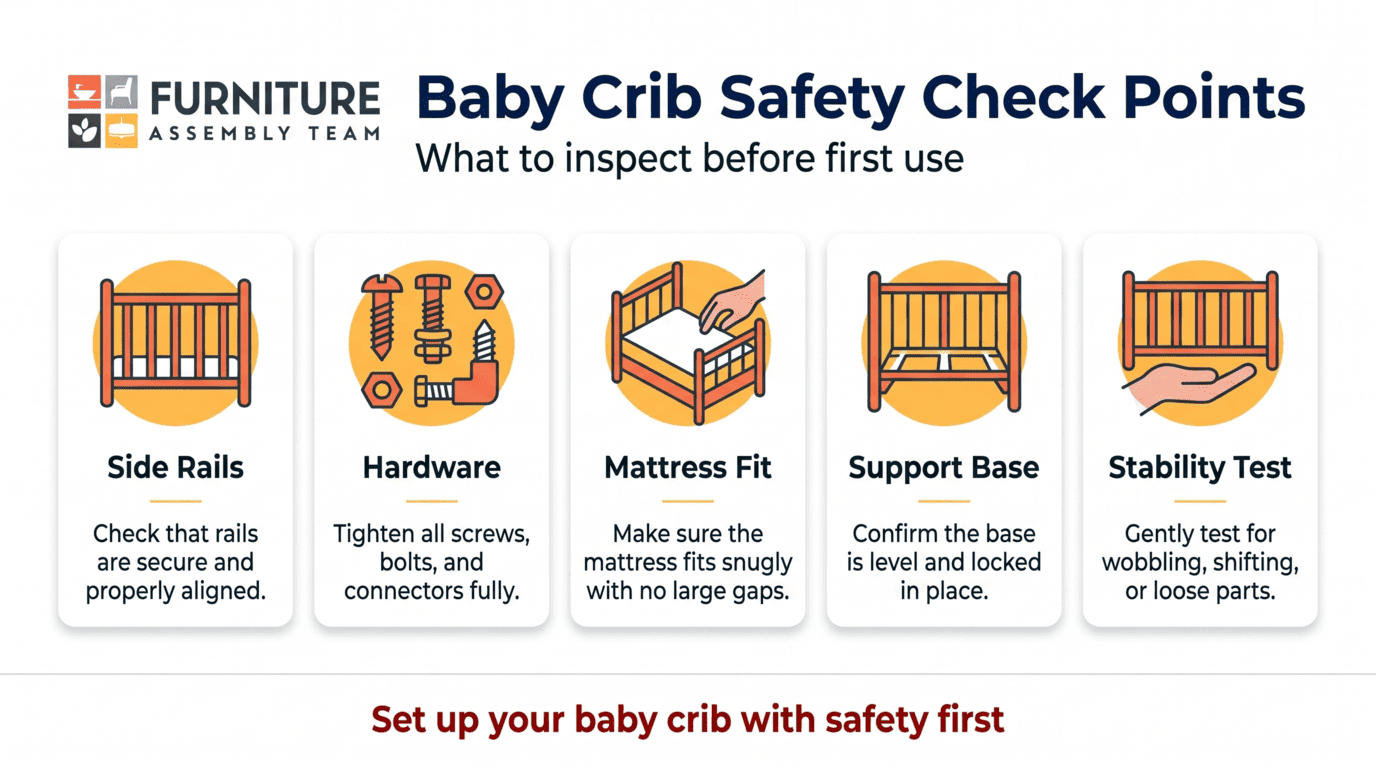
Crib safety checks matter because a crib can look finished and still have hidden setup problems, including loose hardware, missing parts, poor mattress fit, or a frame that shifts under pressure. Before first use, parents should always confirm the crib is stable, all approved parts are installed, and the mattress fits snugly without gaps.
- Check every screw, bolt, bracket, and mattress support connection after assembly
- Stop immediately if any part is missing, substituted, cracked, or does not line up correctly
- Test for wobble by pressing on the side rails, corners, and mattress support
- Make sure the crib mattress sits snugly with no large side gaps
- Recheck the crib after moving it, adjusting mattress height, or weeks of daily use
Crib assembly often looks straightforward until the last few steps reveal a misaligned rail, an extra bolt, or a mattress that does not sit quite right. Then the risk grows. A small setup error can affect stability, hardware security, mattress support, and the overall safety of the nursery, especially in apartments, shared family homes, and first-time baby rooms where space is tight.
That is why careful baby crib assembly safety checks matter before a baby ever sleeps in the crib. When the frame is built correctly and inspected with patience, parents, grandparents, and caregivers can catch preventable issues early and avoid the stress of wondering whether the setup is truly safe.
Why Crib Safety Checks Matter Before First Use
Crib safety checks matter before first use because assembly errors are not always obvious. A crib can appear level and complete, yet still have loose fasteners, misaligned rails, or an improperly seated mattress support that affects everyday safety once a baby begins sleeping, rolling, or pulling up.
Why small errors matter
A crib is one of the few pieces of nursery furniture used daily and under changing pressure. The frame must hold steady through routine movement, sheet changes, and later, a growing child shifting weight against the rails. That is why parents should compare their setup against basic safety expectations reflected in the federal guidance for full-size baby cribs.
Safety is not just for new parents
These checks matter just as much for grandparents setting up a guest room, families preparing a second home, or caregivers furnishing a short-term nursery. Standards awareness helps in those settings too, especially where durable, repeated use matters, as reflected in the commercial crib performance specification. For families who need more than crib setup alone, Furniture Assembly Team also offers a broader range of setup help.
Which Parts Should Be Checked Before Assembly
Before assembly starts, check every structural piece, hardware pack, mattress support component, and instruction sheet. Parents should confirm that nothing is cracked, warped, mislabeled, or missing, because the safest crib assembly begins before the first screw is tightened.
Start with the frame and support pieces
Look over the side rails, end panels, slats, legs, stabilizing bars, and mattress platform. If anything appears split, bent, or rough at the connection points, stop there. A damaged part can throw the whole frame out of alignment.
Many families compare several crib styles parents commonly shop before buying, and the hardware needs can differ from one model to another. The same is true for convertible crib formats many parents compare, where extra conversion hardware or drawer components may be included.
Check the hardware pack carefully
Use the instruction manual as a checklist before assembly begins:
- Count screws, bolts, washers, dowels, brackets, and caps
- Separate similar-looking fasteners so they are not mixed up
- Confirm mattress support hooks, pins, or brackets are present
- Verify any anti-tip or wall-anchoring parts for nearby nursery furniture
- Keep manufacturer tools and approved hardware together
If you are also assembling dressers, changing stations, or storage pieces, broader in-home furniture assembly support can keep the whole room organized and reduce mix-ups.
How Tight Should Crib Hardware Be
Crib hardware should be fully tightened to the manufacturer’s recommended fit so the frame feels secure, even, and stable without stripped threads or forced connections. In simple terms, the hardware should be snug enough that the crib does not shift, creak, or loosen under normal pressure.
A crib hardware safety check is a final inspection of every bolt, screw, bracket, and support connection before a baby uses the crib.
What snug really means
If one corner still flexes when you press it, the hardware is not tight enough. If a bolt keeps spinning, sits crooked, or damages the material around it, it may be overtightened, cross-threaded, or installed in the wrong position.
Tighten in sequence
Most cribs assemble best when fasteners are started loosely, the frame is aligned, and then the hardware is tightened in stages. That method helps the rails sit square and keeps pressure balanced across the crib. Rushing one side fully tight before the other is a common reason a crib later feels uneven.
What Causes a Crib to Feel Loose or Unstable
A crib usually feels loose or unstable because of misaligned assembly, partially tightened hardware, an uneven floor, damaged parts, or a mattress support that is not seated correctly. In many cases, the wobble starts small and becomes more noticeable after the crib is moved or used for a few days.
Common causes of wobble
- Side rails tightened before the frame was squared
- Similar screws swapped during assembly
- Mattress platform hooks or brackets not fully engaged
- One leg or corner sitting unevenly on the floor
- A cracked panel, stripped hole, or bent connector
Test the crib the right way
Press gently on each top rail, then the corners, then the mattress support area. A stable crib should feel firm and predictable, not springy or loose. If the frame shifts in one direction only, the issue is often alignment, not just tightness.
Families adding flat-pack pieces beyond the crib often run into the same alignment trouble with nearby storage, shelving, or room furniture, which is why some also seek specialized IKEA furniture assembly help for related household pieces.
Can Missing Parts Affect Crib Safety
Missing parts can absolutely affect crib safety. Even one absent fastener, bracket, pin, or support piece can change how the frame carries weight, how the mattress platform sits, or how securely the sides stay aligned during use.
Never substitute random hardware
A missing washer or bolt may seem minor, but cribs are designed around specific dimensions and connection points. Substituting a similar screw from a toolbox can create uneven pressure, poor fit, or long-term loosening.
Stop and verify before use
If a part is missing, do not use the crib until the correct replacement is confirmed. This matters in first nurseries, guest rooms for visiting babies, and shared-family homes alike. A crib should never be treated as “close enough” when one approved piece is absent.

How Do You Check Mattress Fit Correctly
To check mattress fit correctly, place the mattress flat on the support platform and confirm it sits snugly against the crib sides without significant gaps. The mattress should lie level, support the fitted sheet properly, and stay in position without lifting at the corners or shifting during routine handling.
| Check Point | Safe Result | Warning Sign |
|---|---|---|
| Mattress sits flat on support base | Mattress lies level with no lifting or rocking | One side sits higher, corners lift, or mattress tilts |
| Gap between mattress and crib sides | Fit is snug with no large visible gaps around edges | Noticeable side gaps that make the mattress look undersized |
| Mattress corners | All four corners fit neatly into the crib corners | Corners bunch, curl up, or leave open space |
| Movement during light pressure | Mattress stays in place when pressed gently by hand | Mattress slides, shifts, or drifts away from the frame |
| Fit after adding fitted sheet | Sheet stays smooth and mattress remains secure | Sheet pulls the mattress upward or causes bunching |
| Support across the center | Mattress feels evenly supported from end to end | Middle sags, bows, or feels unsupported |
| Match with crib dimensions | Mattress appears properly sized for that crib model | Mattress looks too short, too narrow, or forced into place |
| Perimeter check after setup | Edges remain consistent on all four sides | One side looks tighter while another has extra space |
What a good fit looks like
A crib mattress fit check is about more than size on the label. The mattress should match the crib’s intended dimensions, sit evenly on the support, and leave no concerning space around the perimeter where a fit issue is obvious.
Use this quick mattress check
- Set the mattress fully flat on the support deck
- Check all four sides for visible gaps
- Make sure the corners sit down evenly
- Confirm the mattress does not bow, tilt, or slide
- Recheck after adding a fitted crib sheet
If you are moving nursery pieces between rooms, a careful approach to mattress handling and room prep can help prevent bending, dragging, or forcing a mattress into the wrong frame.
Common Crib Assembly Mistakes Parents Overlook
The most overlooked crib assembly mistakes are swapped hardware, skipped final tightening, reversed panels, poor mattress support placement, and assuming the crib is safe because it looks complete. These problems are common in first-time setups, late-night assemblies, and busy homes where people are trying to finish the nursery quickly.
Mistakes that happen most often
- Using bolts that look right but belong in a different step
- Tightening one side fully before the frame is aligned
- Installing the mattress support at the wrong height or orientation
- Forgetting a final stability check after cleanup
- Leaving nearby nursery furniture unassembled or unsecured
Parents also miss the connection between crib safety and the rest of the room. A nursery often needs coordinated dresser, bed, and storage setup, especially in apartments or family homes making room for a new baby. That is where professional baby crib assembly can reduce errors, and nearby storage pieces may also benefit from help with IKEA beds and dressers.
Why professional help changes the outcome
Many parents searching for a crib assembly service near me are really trying to avoid preventable setup mistakes. Professional assemblers bring a repeatable process, hardware checks, and experience with common brands, which is especially helpful when the nursery includes more than one complicated piece.
When to Recheck a Crib After Setup
A crib should be rechecked right after assembly, again after it has been moved, after any mattress height adjustment, and periodically during normal use. Rechecking matters because daily pressure, room changes, and small hardware shifts can affect crib stability over time.
Best times to recheck
- Within the first few days after setup
- After moving the crib to another wall or room
- After lowering the mattress support
- If you hear creaking or notice movement
- During routine nursery cleaning
Room changes can affect crib safety
Many nurseries begin as offices, spare rooms, or shared bedrooms. If you are clearing older furniture before setup, furniture disassembly for room conversion can make the space safer and less cramped. Families updating the rest of the room may also use additional home furniture assembly support, especially when new nursery storage arrives with the crib.
Think beyond the crib itself
If the nursery also includes a new adult bed, dresser, or coordinated bedroom pieces for the same room, bedroom set assembly support can help keep the entire space functional and stable instead of solving one furniture issue at a time.
Make Crib Safety Part of Your Setup Routine
Safer crib setup starts with careful assembly, a full hardware check, proper mattress fit, and a final stability test before first use. If you want fewer missed parts, better alignment, and more peace of mind in a nursery, apartment, family home, or guest room for visiting babies, hiring Furniture Assembly Team is a practical next step.
Furniture Assembly Team helps families across Maryland, Washington DC, Delaware, Pennsylvania, and Northern Virginia, including Baltimore, Rockville, Bethesda, Arlington, Alexandria, Wilmington, and Harrisburg. If you need professional crib assembly for a first nursery or a growing-family room refresh, contact Furniture Assembly Team. Families sometimes need more than crib setup at once, from outdoor play areas to broader home projects, and related home services can also include basketball hoop installation or residential trampoline setup.
Frequently Asked Questions
How do you know if a crib is assembled safely?
You know a crib is assembled safely when the frame feels stable, the hardware is fully secured, the mattress support is installed correctly, and the mattress fits snugly. It should not wobble, creak excessively, or have any missing or substituted parts.
How tight should crib screws and bolts be?
Crib screws and bolts should be tightened until the frame is secure and does not shift during normal pressure. They should feel snug and properly seated, not loose, stripped, or forced at an angle.
What makes a crib feel wobbly after setup?
A crib often feels wobbly because the frame is out of alignment, the wrong hardware was used, one corner is uneven, or the mattress support was not installed correctly. Sometimes the wobble only becomes obvious after the crib is moved or used for a few days.
Can you use a crib if one part is missing?
No, a crib should not be used if any approved part is missing. Even a small missing fastener or bracket can affect stability, support, and overall safety.
How should a crib mattress fit?
A crib mattress should sit flat and snug inside the crib without obvious side gaps or raised corners. It should stay level on the support platform and not slide around during routine use.
When should you recheck a crib after assembly?
Recheck a crib immediately after setup, after moving it, after adjusting the mattress height, and during regular use. It is also smart to inspect it again if you hear noise, feel movement, or notice hardware working loose.
Is professional crib assembly better than doing it yourself?
Professional crib assembly can be better when you want experienced hardware checks, stronger alignment, and less risk of setup mistakes. It is especially helpful for first-time parents, grandparents preparing a guest room, and families assembling multiple nursery pieces at once.
What crib mistakes do parents miss most often?
Parents often miss swapped hardware, skipped final tightening, reversed panels, and poor mattress support placement. Another common mistake is assuming the crib is safe because it looks finished without doing a full crib stability and mattress-fit check.