
TV Stand and Entertainment Center Assembly Services
TV stand and entertainment center assembly services help homeowners, renters, apartment residents, and families set up media furniture safely, correctly, and efficiently. The service includes assembling, aligning, leveling, positioning, and organizing the unit so your TV area feels stable, clean, and easy to use.
- Proper assembly helps prevent wobbling, leaning, and loose hardware issues.
- A stable setup improves safety around TVs, shelves, drawers, and media equipment.
- Organized cables make the entertainment area cleaner and easier to maintain.
- Professional setup saves time and helps avoid frustrating assembly mistakes.
A
TV stand can look simple in the box, but the setup can quickly become a headache when parts do not align, cables get messy, or the unit feels unstable after assembly. Small mistakes like loose fasteners, reversed panels, uneven placement, or poor cable planning can affect safety, storage, and daily use. Furniture Assembly Team helps avoid those problems with professional
TV stand and entertainment center assembly services focused on strength, clean alignment, practical layout, and a finished setup that works for your living space.
Why Professional TV Stand and Entertainment Center Assembly Matters
Professional TV stand and entertainment center assembly matters because these units often support expensive TVs, media devices, speakers, routers, gaming systems, and storage items. Correct assembly improves safety, stability, alignment, and everyday usability, especially for larger or more detailed entertainment furniture.
Safety Starts With Proper Assembly
A TV stand needs more than a few tightened screws to be safe. The frame, shelves, drawers, brackets, and support panels all work together. If one part is installed incorrectly, the unit may wobble, lean, or carry weight unevenly.
Loose cam locks, missing hardware, and uneven shelves can create problems over time. A stand that feels “good enough” on day one may become less stable once a TV, soundbar, books, consoles, and decor are added.
Why Hiring a Pro Saves Time
Furniture Assembly Team helps customers avoid preventable setup issues by checking the parts, following the correct build order, aligning movable sections, and placing the finished unit properly. For customers setting up more than one item, broader
home furniture assembly support can make the entire room easier to finish without turning the project into a full weekend mission.
What Types of TV Stands and Entertainment Centers Can Be Assembled
TV stand assembly services cover many furniture styles, from small media consoles to large entertainment centers with cabinets, shelves, towers, drawers, and storage sections. The best assembly approach depends on the size, materials, weight distribution, hardware, and final placement of the unit.
Furniture Assembly Team can assemble common entertainment furniture such as:
- Open media consoles with shelving for gaming systems and streaming devices
- Enclosed TV stands with drawers, cabinets, sliding doors, or glass panels
- Large entertainment centers with side towers, bridges, and storage sections
- Corner TV stands for tighter rooms or angled layouts
- Fireplace TV stands with inserts and ventilation needs
- Modular media storage units with multiple connected parts
- Floating-style units that still require careful frame assembly
- Mixed-material units with wood, metal, glass, or composite panels
Many customers buy units similar to
TV stands and media furniture from Pottery Barn, larger
entertainment centers sold through Wayfair, or popular
television stand styles on Amazon. These pieces often arrive with many panels, fasteners, brackets, and small parts, so professional assembly helps keep the process smooth and the final setup stronger.
Who Benefits From Professional Assembly Services
Professional assembly benefits anyone who wants a safer, cleaner, and faster TV stand or entertainment center setup without dealing with confusing instructions, heavy panels, or alignment problems. It is especially useful for large furniture, busy households, apartments, rentals, and full living-room upgrades.
Homeowners and Renters
Homeowners often hire Furniture Assembly Team when refreshing a family room, media room, basement lounge, or main living area. Renters and apartment residents use professional assembly to avoid damaging floors, walls, or furniture during setup.
Busy Families and New Movers
Busy families benefit because the job gets handled without leaving boxes, tools, and half-built furniture in the living room. People moving into new homes often need several pieces assembled quickly, especially when the TV area is one of the first spaces they want ready.
Property and Rental Setups
Short-term rental owners and property managers also benefit from professional entertainment center assembly. A clean, stable TV area makes a furnished space feel more complete and guest-ready.
If the entertainment setup is part of a larger living room project, sofa and sectional assembly services can help finish the seating area with less back and forth.
How TV Stand and Entertainment Center Assembly Works
TV stand and entertainment center assembly usually starts with reviewing the space, checking parts, assembling the frame, installing shelves or drawers, aligning the unit, leveling it, placing it correctly, and clearing the work area. The goal is a sturdy, clean, and usable setup.
A typical assembly process includes:
- Reviewing the room and final placement area
- Checking panels, screws, brackets, hinges, drawer slides, and hardware
- Building the base and frame in the correct order
- Installing shelves, drawers, cabinet doors, or side towers
- Aligning doors and drawer fronts for smoother use
- Leveling the unit so it sits properly on the floor
- Positioning the stand for viewing, storage access, and cable reach
- Clearing packaging so the area is ready to use
Large entertainment centers may require extra care because tall sections, bridges, and wide frames can shift during setup. If an older unit needs to be removed before the new one goes in, professional wall unit dismantling support can make the transition cleaner and safer.
How to Choose the Right Setup for Your Space
The right entertainment setup depends on room size, TV size, walking clearance, storage needs, viewing distance, outlet location, and how the space is used every day. A good setup should support the TV safely while keeping devices accessible and the room comfortable.
Match the Unit to the Room
In a small apartment, a low-profile media console may work better than a tall entertainment wall. In a large living room, a wider entertainment center can help balance the space and provide extra storage for media devices, books, games, and decor.
Think About Viewing Height
TV height matters. A screen that sits too high can feel uncomfortable, while one placed too low may not work well with deep seating or sectionals. The stand should support the screen at a practical viewing level based on the seating layout.
For buyers still comparing furniture sizes and placement ideas, this TV stand and entertainment center setup guide can help with planning before assembly day.
Some rooms also work better with a wall-mounted TV above a media console. If you are comparing stand placement with mounting, this TV mounting setup guide can help you think through layout, height, and safety.
What Causes TV Stands to Feel Unstable or Unsafe
TV stands usually feel unstable because of loose hardware, uneven floors, incorrect part placement, overloaded shelves, missing fasteners, or rushed assembly. Even a small mistake can affect balance once the unit holds a TV, soundbar, gaming console, router, or decor.
Loose or Incorrect Hardware
The most common issue is hardware that was not installed correctly. Cam locks, dowels, screws, brackets, and support pieces must be secured in the right order. If the frame is not square, the whole stand can shift or wobble.
Uneven Floors and Poor Weight Distribution
Uneven floors can make a stand feel unsafe even when the unit itself is assembled correctly. Weight distribution matters too. Heavy items should be placed where the stand is designed to carry them, not randomly on weaker shelves or unsupported sections.
Furniture Assembly Team checks alignment, leveling, and placement during setup so the finished unit feels solid before your TV and media devices are added.
| Cause | Quick Fix |
|---|---|
| Loose hardware | Tighten connections properly |
| Uneven floor | Level the unit |
| Wrong part placement | Recheck assembly order |
| Overloaded shelves | Follow weight limits |
| Rushed setup | Hire professional assembly |
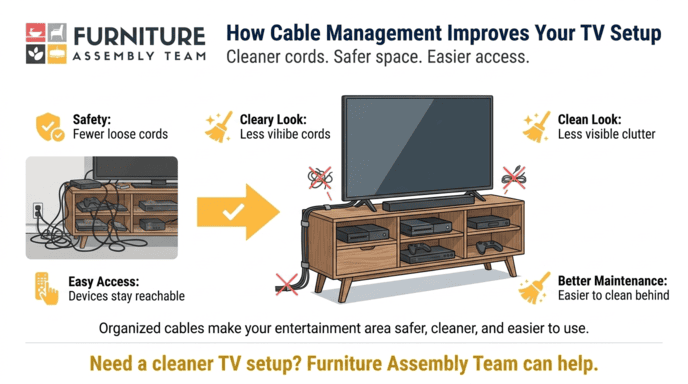
How Cable Management Improves Your Setup
Cable management improves your TV stand setup by reducing visible clutter, making devices easier to access, lowering trip hazards, and keeping the entertainment area easier to clean. A clean cable path also helps the finished setup look more intentional and less chaotic.
Why Cable Clutter Becomes a Problem
Behind many TV stands, cables quickly turn into a nest. Power cords, HDMI cables, gaming systems, streaming devices, routers, speakers, chargers, and extension cords often compete for the same small space.
When cords are tangled, it becomes harder to troubleshoot devices, clean behind the unit, or move equipment safely. Power-strip crowding can also make the area look messy and difficult to manage.
Cleaner Setup, Easier Use
Good cable organization groups cords by use, routes them toward outlets, and keeps them from being pinched behind heavy furniture. For a more complete entertainment setup, some homeowners combine stand assembly with TV mounting services so the screen, furniture, devices, and cable routes work together.
Common Assembly Mistakes That Affect Performance
Common DIY assembly mistakes include reversed panels, skipped steps, misaligned doors, uneven drawers, overtightened hardware, missed leveling, and poor cable planning. These issues can affect safety, function, appearance, and the long-term usability of the entertainment area.
Panel and Hardware Errors
Reversed panels are a classic flat-pack problem. One wrong facing board can cause shelves, doors, or back panels to sit incorrectly. Skipped steps can also create bigger issues later because many TV stands depend on a specific build sequence.
Overtightening can strip screws, damage composite wood, or weaken connection points. Under-tightening creates movement. Both can shorten the life of the unit.
Alignment and Function Problems
Misaligned drawers and doors may still open, but they make the unit look unfinished. Over time, poor alignment can cause rubbing, sticking, or uneven wear. Cable planning is another common miss. If cords are not considered before final placement, the unit may need to be moved again, which increases the risk of scratches, floor marks, or strain on the frame.

How to Plan a Clean and Functional Entertainment Area
A clean and functional entertainment area starts with smart placement, comfortable viewing, proper clearance, accessible storage, organized cables, and room for future devices. The best setup should look good, work well, and stay easy to use after assembly.
Start With Daily Use
Think about how people actually use the room. The TV stand should work with the sofa, sectional, chairs, and walking paths. It should not block doorways, crowd the room, or make it difficult to reach storage areas.
Cabinet doors and drawers need space to open. Game consoles, routers, speakers, and remotes need practical locations. This is where good placement does the heavy lifting.
For bigger layout decisions, this guide on how setup and placement can prevent damage gives helpful context for avoiding tight, awkward, or risky furniture arrangements.
Finish the Entertainment Wall
A polished entertainment area may include framed photos, shelves, artwork, or decor around the media setup. Professional art and picture hanging support can help complete the wall without making it feel crowded or off-balance.
Get a Stable and Organized Entertainment Setup
Get your TV stand or entertainment center assembled the right way with Furniture Assembly Team. For safer assembly, cleaner cables, better alignment, and a polished living room setup,
contact Furniture Assembly Team today. If your project also includes
office furniture assembly,
disposal and recycling help, or
basketball hoop installation guidance, additional setup support may also be useful.
Frequently Asked Questions
How long does TV stand assembly take?
Most TV stand assembly takes one to three hours, depending on the size, number of parts, and complexity of the unit. Large entertainment centers with drawers, cabinets, shelves, or side towers may take longer because alignment and leveling require extra care.
Why does a TV stand wobble?
A TV stand usually wobbles because hardware is loose, parts are misaligned, the floor is uneven, or the unit was not assembled in the correct order. Weight placed unevenly across shelves or cabinets can also make the stand feel less secure.
How much weight can a TV stand hold?
A TV stand can only hold the weight listed by the manufacturer for the top surface and each shelf. The safest approach is to check the product specifications and avoid placing oversized TVs or heavy equipment on a unit not designed for that load.
Is professional TV stand assembly worth it?
Yes, professional TV stand assembly is worth it when you want a safer, sturdier, and cleaner setup without wasting time on confusing instructions. It is especially helpful for large units, heavy furniture, entertainment centers with many parts, or rooms where placement matters.
How do you manage cables behind a TV stand?
Cable management starts by grouping cords, routing them toward outlets, and keeping power, HDMI, and device cables easier to identify. A cleaner cable layout improves appearance, reduces tangles, and makes it easier to access equipment later.
Can entertainment centers be assembled in apartments?
Yes, entertainment centers can be assembled in apartments as long as there is enough floor space to build and position the unit safely. Professional assembly is helpful in apartments because tight rooms, elevators, narrow hallways, and limited workspace can make setup more difficult.
What causes drawers or doors to sit unevenly?
Uneven drawers or doors are usually caused by misaligned hinges, incorrect drawer slide placement, uneven frame assembly, or skipped adjustment steps. Careful alignment during assembly helps doors close properly and drawers slide more smoothly.